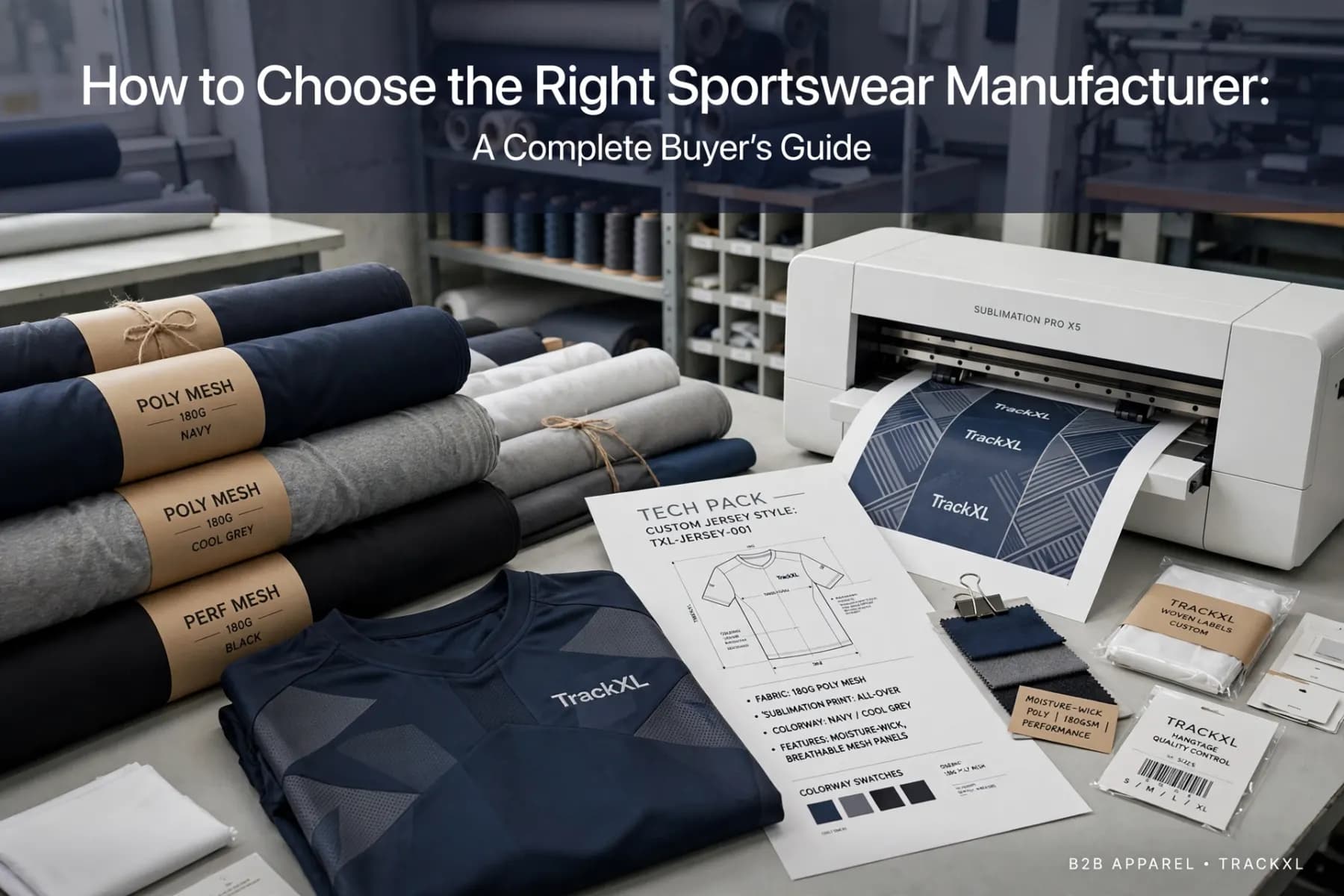
How to Choose the Right Sportswear Manufacturer: The Ultimate Buyer's Guide
Estimated Reading Time: 15–20 Minutes
Whether you're launching a new sportswear brand, sourcing uniforms for a sports club, expanding your product line, or looking for a reliable manufacturing partner, choosing the right sportswear manufacturer is one of the most important business decisions you'll make.
The manufacturer you choose doesn't just produce garments—they become a key part of your supply chain. Their quality standards, communication, production capabilities, and reliability directly influence your customer satisfaction, delivery timelines, and long-term brand reputation.
Many businesses focus only on finding the lowest price. While cost is important, it should never be the only deciding factor. A cheaper manufacturer may save money initially but can create bigger problems later through inconsistent quality, delayed shipments, poor communication, or products that don't meet expectations.
On the other hand, a dependable manufacturing partner helps your business deliver consistent quality, maintain customer trust, and scale production as demand grows.
This guide is designed to help sports brands, wholesalers, distributors, retailers, schools, universities, sports clubs, and startups understand exactly what to look for when selecting a sportswear manufacturer. Rather than promoting one company, we'll focus on the practical factors that experienced buyers evaluate before placing an order.
By the end of this guide, you'll know how to compare manufacturers, avoid common mistakes, ask the right questions, and make a confident decision that supports your business for years to come.
Table of Contents
Why Choosing the Right Sportswear Manufacturer Matters
Define Your Business Goals Before Contacting Suppliers
Understanding Different Types of Sportswear Manufacturers
What Makes a Reliable Manufacturer?
Key Questions to Ask Before Requesting a Quote
Why Choosing the Right Sportswear Manufacturer Matters
Finding a manufacturer is easy.
Finding the right manufacturer is much more difficult.
A manufacturing partner influences almost every stage of your business—from product quality and production schedules to customer satisfaction and repeat orders.
Imagine launching your new sportswear collection after months of planning. Your designs are complete, marketing campaigns are ready, and customers begin placing orders. If the manufacturer delivers products with poor stitching, incorrect colors, inconsistent sizing, or delayed shipping, your customers won't blame the factory—they'll blame your brand.
That is why experienced buyers evaluate manufacturers carefully before discussing pricing.
A reliable sportswear manufacturer helps you:
Produce consistent, high-quality apparel.
Maintain accurate sizing across production batches.
Meet delivery deadlines.
Scale production as your business grows.
Reduce manufacturing risks.
Build long-term customer trust.
Protect your brand reputation.
Support future product development.
Choosing the right manufacturer isn't simply about today's order. It's about building a long-term business relationship that can grow alongside your company.
Buyer Insight: The cheapest quote rarely provides the best long-term value. Consistent quality, clear communication, and dependable production often save more money than choosing the lowest initial price.
Define Your Business Goals Before Contacting Suppliers
Many buyers begin searching for manufacturers without clearly defining what they actually need.
This often leads to inaccurate quotations, misunderstandings, and production delays.
Before contacting any manufacturer, spend time answering a few important questions.
Who is your target customer?
Understanding your audience helps determine the right materials, construction, and customization options.
For example:
Professional sports teams
Amateur clubs
Schools
Universities
Fitness brands
Retail clothing brands
Corporate sports events
Promotional apparel
Each customer segment has different expectations regarding quality, durability, and budget.
What level of customization do you need?
Some businesses require only basic logo printing, while others need complete product customization.
Common customization options include:
Custom jersey designs
Player names and numbers
Team logos
Sublimation printing
Embroidery
Heat transfer printing
Woven labels
Neck labels
Hang tags
Individual packaging
Custom sizing
Retail-ready packaging
The more detailed your requirements, the more important it becomes to work with a manufacturer experienced in custom production.
Estimate Your Order Quantity
Manufacturers often ask about expected order volume because production planning depends on quantity.
Typical order types include:
Sample orders
Small business launches
Club uniforms
Wholesale orders
Seasonal collections
Large retail production
Providing realistic quantity estimates helps manufacturers recommend suitable production methods and timelines.
Understanding Different Types of Sportswear Manufacturers
Not all manufacturers operate the same way.
Understanding these manufacturing models helps you choose the right partner for your business.
OEM (Original Equipment Manufacturer)
OEM manufacturing allows you to provide your own product designs, specifications, logos, and branding while the manufacturer produces the garments according to your instructions.
This model is ideal for:
Established sportswear brands
Sports clubs
Retail chains
Businesses with original designs
Companies that already have technical specifications
OEM offers maximum control over product development and brand identity.
Private Label Manufacturing
Private label manufacturing allows businesses to sell products under their own brand name while production is handled by an experienced manufacturer.
This option is popular among:
Startup clothing brands
Online retailers
Fitness businesses
Boutique stores
Importers
Private label helps businesses launch products more efficiently without investing in their own manufacturing facilities.
ODM (Original Design Manufacturer)
An ODM manufacturer develops products based on existing designs that buyers can customize with their own branding.
This model is useful for businesses that want faster product development while still creating a unique brand identity.
CMT (Cut, Make, Trim)
CMT manufacturers focus primarily on production.
The buyer typically provides:
Fabric
Patterns
Technical specifications
Accessories
Branding materials
The manufacturer performs cutting, sewing, and garment assembly according to the buyer's instructions.
Full Package Production (FPP)
Full Package Production is one of the most comprehensive manufacturing solutions.
The manufacturer manages most stages of production, including:
Product development
Fabric sourcing
Pattern making
Sampling
Bulk manufacturing
Quality control
Packaging
Export preparation
This approach is especially valuable for businesses that prefer working with a single manufacturing partner throughout the production process.
Which Manufacturing Model Is Best?
There is no single answer.
The right choice depends on:
Your business experience.
Product complexity.
Budget.
Branding goals.
Available technical resources.
Long-term growth strategy.
Many successful brands begin with private label production and gradually transition toward OEM manufacturing as their business expands and product requirements become more specialized.
2. The Complete Guide to Sportswear Fabrics
Choosing the right fabric is one of the most important decisions in sportswear manufacturing. Even an excellent design can disappoint customers if the material does not perform well during training or competition.
The ideal sportswear fabric depends on several factors, including the sport, climate, level of activity, printing method, durability requirements, and budget. Rather than selecting fabric based only on price, buyers should understand how different materials behave in real-world use.
A knowledgeable manufacturer should help you compare fabric options and recommend the most suitable material for your specific product instead of suggesting the same fabric for every order.
Key Factors to Consider When Choosing Sportswear Fabric
Before selecting any fabric, consider the following questions:
Will the garment be used indoors or outdoors?
Is it designed for professional athletes or casual wear?
Does it need moisture-wicking performance?
Will the garment be fully sublimated?
Should it be lightweight or heavier for durability?
Will it be worn in hot or cold climates?
How often will it be washed?
The answers help determine which fabric offers the best balance of comfort, performance, durability, and appearance.
Popular Sportswear Fabrics
Polyester Interlock
Polyester Interlock is one of the most widely used fabrics in sportswear manufacturing.
Best For
Football jerseys
Basketball uniforms
Cricket jerseys
Volleyball uniforms
Baseball jerseys
Team training apparel
Advantages
Lightweight
Smooth surface
Excellent for sublimation printing
Durable
Moisture-wicking
Easy to maintain
Quick drying
Because of its versatility, polyester interlock remains one of the most popular choices for custom sports uniforms.
Bird Eye Mesh
Bird Eye Mesh features a textured surface with tiny ventilation holes that improve airflow.
Best For
Football
Running
Cycling
Training wear
Activewear
Advantages
Excellent breathability
Lightweight feel
Moisture management
Comfortable in warm weather
Suitable for intense physical activity
This fabric is ideal when ventilation and comfort are top priorities.
Micro Mesh
Micro Mesh is designed for maximum airflow and comfort during demanding sports.
Advantages
Superior ventilation
Lightweight construction
Soft feel
Excellent moisture management
It is commonly used in premium team uniforms and high-performance training apparel.
Spandex Blends
Spandex provides stretch and flexibility, allowing garments to move naturally with the athlete.
Best For
Compression wear
Gym apparel
Cycling shorts
Performance leggings
Fitness clothing
Advantages
Four-way stretch
Excellent recovery
Comfortable fit
Freedom of movement
French Terry
French Terry combines comfort with moderate warmth.
Common Uses
Hoodies
Joggers
Casual sportswear
Warm-up apparel
It is a popular choice for brands producing premium lifestyle sportswear.
Cotton Fleece
Cotton fleece offers warmth and comfort for cooler weather.
Best For
Hoodies
Sweatshirts
Tracksuits
Although not typically used for match jerseys, it is excellent for team apparel and casual collections.
Fabric Weight (GSM)
GSM stands for Grams per Square Meter and indicates fabric weight.
Generally:
Lower GSM = lighter fabric
Higher GSM = thicker fabric
The ideal GSM depends on the intended product.
For example, lightweight football jerseys usually require lower GSM than heavyweight hoodies or sweatshirts.
A professional manufacturer should recommend GSM based on product performance rather than using a single weight across every garment.
Buyer Tip: Always ask your manufacturer not only which fabric they use, but also its GSM and why it is suitable for your product.
Moisture-Wicking Technology
Modern sportswear is designed to keep athletes comfortable by moving perspiration away from the skin.
Moisture-wicking fabrics help:
Reduce discomfort
Improve breathability
Dry more quickly
Enhance athletic performance
This feature is particularly valuable for football, basketball, volleyball, running, and gym apparel.
Color Performance
A quality sportswear fabric should maintain vibrant colors even after repeated washing.
Ask manufacturers about:
Colorfastness
UV resistance (if relevant)
Wash durability
Printing compatibility
Consistent color performance is especially important for team uniforms and branded merchandise.
Understanding Sportswear Printing Methods
Printing quality has a major impact on the final appearance of custom apparel.
The best printing method depends on the product, design complexity, quantity, and intended use.
Sublimation Printing
Sublimation has become one of the most popular printing methods for sports jerseys.
Unlike surface printing, sublimation transfers ink directly into polyester fibers.
Advantages
Vibrant colors
No cracking
No peeling
Lightweight finish
Long-lasting performance
Unlimited design possibilities
This makes sublimation ideal for football, basketball, rugby, cricket, baseball, and volleyball uniforms.
Screen Printing
Screen printing remains a reliable option for simple graphics and large production runs.
Best For
Basic logos
Team names
Promotional apparel
Advantages include durability and cost efficiency for straightforward designs.
Heat Transfer Printing
Heat transfer printing is often used for:
Player names
Numbers
Sponsor logos
Limited production runs
It provides flexibility when customization is required after garments have been manufactured.
Embroidery
Embroidery creates a premium, textured appearance that is commonly used for:
Polo shirts
Hoodies
Jackets
Team apparel
Corporate uniforms
It offers a professional finish and excellent durability.
Silicone and Rubber Logos
Modern sportswear brands increasingly use silicone or rubber logos for a contemporary appearance.
These logos add texture and visual depth while maintaining durability.
Puff Printing
Puff printing creates a raised three-dimensional effect.
It is commonly used for:
Fashion sportswear
Lifestyle collections
Premium hoodies
Streetwear-inspired athletic apparel
How the Manufacturing Process Works
Although every manufacturer follows slightly different procedures, a professional sportswear production process generally includes several important stages.
Step 1 – Design Consultation
The buyer shares ideas, reference images, logos, technical specifications, or a tech pack.
Clear communication during this stage reduces production errors later.
Step 2 – Fabric Selection
The manufacturer recommends suitable fabrics based on:
Product type
Performance requirements
Printing method
Budget
Climate
Step 3 – Pattern Development
Patterns are created according to approved measurements and sizing specifications.
Accurate patterns are essential for consistent garment fit.
Step 4 – Sample Production
Before bulk manufacturing begins, a sample is produced for evaluation.
This allows the buyer to review:
Fit
Colors
Fabric
Printing
Stitching
Overall appearance
Sample approval is one of the most important stages in the entire production process.
Step 5 – Bulk Manufacturing
Once the sample is approved, production moves to full manufacturing.
This stage includes:
Fabric cutting
Printing
Sewing
Assembly
Trimming
Finishing
Step 6 – Quality Inspection
Professional manufacturers inspect garments at multiple stages rather than waiting until production is complete.
Quality checks may include:
Fabric inspection
Stitch quality
Print accuracy
Measurements
Logo placement
Final appearance
Early inspections help identify issues before they affect the entire order.
Step 7 – Packing and Shipping
After final approval, garments are folded, packed, labeled, and prepared for shipment according to the buyer's requirements.
Packaging can include custom bags, cartons, barcodes, or retail-ready presentation depending on the order.
Why Quality Control Is Essential
Quality control is not a single inspection at the end of production. It is an ongoing process that protects both the manufacturer and the buyer.
A well-managed quality control system helps ensure:
Consistent sizing
Accurate colors
Secure stitching
Proper logo placement
Clean finishing
Correct quantities
Reliable manufacturers understand that consistent quality leads to stronger long-term business relationships and greater customer confidence.
Manufacturing Insight: Experienced buyers often ask about a factory's quality control process before discussing pricing. This reflects an understanding that preventing defects is usually less costly than correcting them after production has finished.
3. Minimum Order Quantity (MOQ): What Every Buyer Should Know
One of the first questions buyers ask is:
"What is your MOQ?"
MOQ, or Minimum Order Quantity, is the smallest number of units a manufacturer is willing to produce for a specific order.
However, MOQ is not the same for every product. It can vary depending on factors such as:
Product type
Fabric selection
Printing method
Number of colors
Custom accessories
Production complexity
For example, a fully sublimated football jersey with custom names and numbers may have different production requirements than a basic cotton T-shirt.
Instead of looking only for the manufacturer with the lowest MOQ, consider whether they can consistently deliver the quality, communication, and service your business needs.
Buyer Tip: Ask your manufacturer why they have a particular MOQ. Understanding the reason behind it often helps you make a better purchasing decision.
Understanding Sportswear Pricing
Many buyers compare quotations from different manufacturers and immediately choose the lowest price.
This approach can create problems later.
A quotation reflects far more than the cost of the fabric.
Several factors influence the final price, including:
Fabric Quality
Premium fabrics generally cost more than standard materials but often provide better comfort, durability, and long-term value.
Printing Method
Different decoration methods have different production costs.
Examples include:
Sublimation Printing
Screen Printing
Embroidery
Heat Transfer
Silicone Logos
Puff Printing
Each method requires different equipment, materials, and production time.
Customization
Additional customization can affect production costs.
Examples include:
Player names
Numbers
Sponsor logos
Custom labels
Hang tags
Individual packaging
Special trims
Order Quantity
Larger production runs often reduce the cost per garment because manufacturing resources are used more efficiently.
Shipping Method
Delivery costs depend on:
Destination country
Shipment size
Air freight
Sea freight
Express courier services
When comparing quotations, always consider the complete value offered rather than focusing solely on price.
Production Capacity
Your manufacturer should be capable of supporting your business as it grows.
Ask questions such as:
How many garments can you produce each month?
Can you handle repeat orders?
How do you manage seasonal demand?
What happens if I need an urgent order?
Choosing a manufacturer with suitable production capacity helps prevent delays during busy seasons.
Lead Time
Lead time refers to the total time required to complete an order.
Although every project is different, production generally includes:
Design review
Sample development
Sample approval
Material preparation
Bulk production
Quality inspection
Packaging
Shipping
Many delays occur because buyers approve samples late or make design changes after production has started.
Providing complete information early helps keep the project on schedule.
Communication Can Make or Break a Project
Strong communication is one of the most valuable qualities a manufacturing partner can offer.
Professional communication includes:
Responding promptly to inquiries.
Providing clear production timelines.
Explaining technical details in simple language.
Sharing progress updates during manufacturing.
Informing buyers about any unexpected issues.
A manufacturer who communicates openly builds confidence throughout the production process.
Questions Every Buyer Should Ask Before Placing an Order
Before confirming production, ask your supplier questions such as:
About the Factory
How long have you been manufacturing sportswear?
Which countries do you regularly export to?
What sportswear products do you specialize in?
About Quality
Can you provide samples?
How do you inspect products during production?
How do you ensure consistent sizing?
About Customization
Can you manufacture according to my design?
Do you provide private labeling?
Can you produce custom packaging?
About Production
What is the estimated production timeline?
How much production capacity do you have?
What happens if changes are required after sampling?
About Shipping
Which shipping methods do you recommend?
Do you assist with export documentation?
Can you arrange international delivery?
Asking these questions helps you compare manufacturers objectively rather than relying only on marketing claims.
Common Mistakes Buyers Should Avoid
Many businesses face unnecessary challenges because they overlook important details during the purchasing process.
Here are some of the most common mistakes.
Choosing Only the Lowest Price
Lower prices may seem attractive, but they should never be the only deciding factor.
Evaluate quality, communication, reliability, and production experience alongside cost.
Skipping the Sample Stage
Approving a sample allows you to verify:
Fabric
Colors
Fit
Printing
Construction
Skipping this step increases the risk of costly corrections later.
Ignoring Communication
Poor communication often leads to misunderstandings regarding production schedules, specifications, and delivery expectations.
Choose a manufacturer who answers questions clearly and keeps you informed throughout the process.
Providing Incomplete Design Files
Supplying clear artwork, measurements, logos, and specifications helps prevent production errors.
The more complete your information, the smoother the manufacturing process becomes.
Focusing Only on Today's Order
Instead of selecting a manufacturer solely for a single project, think about your long-term business goals.
A reliable manufacturing partner should be able to support future collections, larger production volumes, and new product categories as your business grows.
A Practical Buyer Checklist
Before placing your order, confirm the following:
✔ Product specifications are finalized.
✔ Logos and artwork are approved.
✔ Fabric selection has been confirmed.
✔ Size chart has been reviewed.
✔ Sample has been approved.
✔ Printing method has been selected.
✔ Packaging requirements have been discussed.
✔ Production timeline is agreed upon.
✔ Shipping method is confirmed.
✔ Payment terms are understood.
Completing this checklist helps reduce misunderstandings and creates a smoother production experience for both the buyer and the manufacturer.
Industry Insight
Experienced buyers rarely choose a manufacturer after receiving just one quotation.
Instead, they compare suppliers based on:
Product quality
Manufacturing capabilities
Communication
Production consistency
Customization options
Delivery performance
Long-term partnership potential
Price remains important, but it is only one part of the overall decision-making process.
Businesses that invest time in selecting the right manufacturing partner often experience fewer production issues and build stronger customer relationships over time.
4. How to Identify a Reliable Sportswear Manufacturer
Finding a sportswear manufacturer is easy. Finding a manufacturing partner that consistently delivers quality, communicates effectively, and supports your long-term business goals requires careful evaluation.
Many manufacturers can produce sportswear, but not every manufacturer follows the same standards. Before making your decision, look beyond product photos and pricing. A professional manufacturing partner should demonstrate reliability through their processes, communication, and willingness to answer your questions.
Below are some of the key qualities experienced buyers look for when evaluating a sportswear manufacturer.
1. Industry Experience
Experience doesn't simply mean being in business for many years. It also means understanding different sports, garment construction, printing methods, and customer expectations.
Manufacturers with experience in football, basketball, rugby, cricket, volleyball, baseball, cycling, fitness apparel, and teamwear are often better equipped to recommend suitable materials and production methods for different projects.
Rather than asking only, "How long have you been in business?" consider asking:
Which products do you manufacture most frequently?
What types of customers do you typically work with?
Can you provide examples of previous production work?
These questions often reveal far more about a manufacturer's capabilities than years of operation alone.
2. Product Samples
Professional manufacturers understand that buyers want to inspect quality before committing to bulk production.
A sample allows you to evaluate:
Fabric feel
Stitching quality
Color accuracy
Printing quality
Logo placement
Overall finishing
Packaging
Reviewing a sample reduces uncertainty and provides an opportunity to request adjustments before large-scale manufacturing begins.
3. Transparent Communication
Communication is one of the strongest indicators of a reliable manufacturing partner.
Professional manufacturers typically:
Reply within a reasonable timeframe.
Explain technical details clearly.
Share realistic production schedules.
Keep buyers informed throughout production.
Communicate potential delays honestly.
Clear communication builds confidence and helps prevent misunderstandings that could affect delivery schedules or product quality.
4. Consistent Quality Control
Quality should never depend on luck.
Reliable manufacturers implement inspection procedures throughout production rather than relying solely on a final inspection.
Quality checks may include:
Fabric inspection
Printing inspection
Measurement verification
Stitching inspection
Final appearance review
Packaging inspection
A structured quality control process helps ensure consistency across every production batch.
5. Customization Capabilities
Every brand has unique requirements.
A capable manufacturer should offer flexibility in areas such as:
Custom designs
Team names
Player numbers
Club logos
Private labels
Woven labels
Hang tags
Retail packaging
Embroidery
Sublimation printing
The ability to customize products allows businesses to create apparel that reflects their own brand identity.
6. Export Experience
For international buyers, export experience is an important consideration.
Manufacturers familiar with global shipping requirements can often provide guidance regarding:
Export documentation
Packaging standards
Shipping methods
Delivery planning
Customs procedures
Working with an export-oriented manufacturer can make international purchasing more efficient.
10 Red Flags to Watch Out For
Not every manufacturer is the right fit. Here are some warning signs that buyers should pay attention to.
Red Flag #1
The manufacturer avoids answering technical questions.
Professional manufacturers should be able to explain fabrics, production methods, and quality standards clearly.
Red Flag #2
Prices seem unrealistically low compared to other quotations.
A very low price may indicate lower-quality materials, reduced quality control, or hidden costs later in the project.
Red Flag #3
No samples are available.
While policies differ, manufacturers should generally be willing to discuss sample options before large production runs.
Red Flag #4
Communication is slow or inconsistent.
If communication is difficult before production begins, it may become even more challenging during manufacturing.
Red Flag #5
The manufacturer cannot explain their production process.
A professional manufacturer should be comfortable discussing how garments move from design to finished product.
Red Flag #6
There is little evidence of manufacturing capability.
Buyers should look for authentic production photos, factory information, or examples of completed work rather than relying only on marketing images.
Red Flag #7
Delivery promises seem unrealistic.
Reliable manufacturers provide realistic timelines instead of promising impossible delivery dates simply to secure an order.
Red Flag #8
Quality control is never discussed.
A manufacturer who cannot explain their inspection procedures may not have a structured quality system.Red Flag #9
Quotations lack important details.
Professional quotations normally specify product details, customization requirements, quantities, timelines, and payment terms.
Red Flag #10
Every answer sounds like a sales pitch.
Experienced manufacturers educate buyers and explain their processes rather than claiming to be "the best" without supporting information.
Real Buyer Scenario
Imagine two businesses launching their own sportswear brands.
Business A
They choose the lowest quotation without requesting a sample.
During production they discover:
Fabric quality differs from expectations.
Colors are inaccurate.
Sizes vary between garments.
Production takes longer than expected.
The result is delayed product launches and additional costs.
Business B
Before placing an order, they review samples, discuss fabric options, confirm production timelines, and clarify packaging requirements.
Although the preparation takes a little longer, production runs more smoothly and the finished products meet expectations.
This example illustrates why careful planning before manufacturing often saves both time and money.
How TrackXL Works With Sportswear Brands
Every business has different manufacturing goals. Some customers are launching their first sportswear collection, while others manage established brands or supply sports clubs and retailers.
At TrackXL, we believe that successful manufacturing starts with understanding the customer's requirements rather than offering a one-size-fits-all solution.
Our process begins by discussing the customer's product, intended market, preferred fabrics, customization requirements, and production goals. From there, we work together to recommend suitable manufacturing options that align with the project.
Our capabilities include:
OEM sportswear manufacturing
Private label production
Custom team uniforms
Sublimation printing
Embroidery
Multiple fabric options
Custom labels and packaging
Worldwide shipping support
More importantly, we encourage buyers to compare manufacturers, request samples, ask technical questions, and make informed decisions. Building long-term partnerships begins with transparency and trust, and we believe informed customers make stronger business partners.
Manufacturing Insight
The most successful manufacturing relationships are built on clear expectations, consistent communication, and mutual trust.
Rather than looking for the "perfect" manufacturer, focus on finding a partner who understands your business objectives, communicates openly, and demonstrates a commitment to quality throughout the production process.
A strong partnership often delivers greater long-term value than simply choosing the lowest quotation.
Explore TrackXL Sportswear Manufacturing Services
Choosing the right sportswear manufacturer is an important step for building a successful brand or supplying high-quality team apparel. Whether you need custom designs, private labeling, team uniforms, or bulk sportswear production, working with an experienced manufacturing partner can help you achieve consistent quality and reliable results.
At TrackXL, we work with sports brands, teams, retailers, and businesses worldwide to develop custom apparel based on their requirements. Our manufacturing capabilities include custom football jerseys, basketball uniforms, rugby kits, cricket uniforms, baseball apparel, volleyball uniforms, training wear, hoodies, and other sportswear products.
From fabric selection and design development to printing, embroidery, quality inspection, and export packaging, we support businesses through every stage of the manufacturing process.
If you are planning your next sportswear collection or looking for a reliable OEM and private label manufacturing partner, explore our product ranges or contact our team to discuss your project requirements.