How to Choose the Best Fabric for BJJ Rash Guards: A Manufacturer’s Guide
Choosing the right fabric is one of the most important decisions when developing a Brazilian Jiu-Jitsu (BJJ) rash guard collection. Fabric affects comfort, stretch, durability, print quality, fit, and the overall performance of the garment during training and competition.
For combat sports brands, selecting a suitable fabric is about more than appearance. The material must perform well during grappling, withstand repeated washing, and maintain its shape and design over time.
At TrackXL, we understand the importance of choosing the right materials when developing custom combat sportswear. Whether you are launching a private-label BJJ apparel brand, expanding an existing collection, or sourcing rash guards for a martial arts academy, understanding fabric specifications can help you make better manufacturing decisions.
In this guide, we explain the main fabric options, GSM, stretch performance, stitching, and printing methods to consider when developing custom BJJ rash guards.
1. What Is the Best Fabric for BJJ Rash Guards?
The best fabric for a BJJ rash guard generally combines polyester or nylon with elastane (also known as spandex). These stretch fabrics are commonly used in compression sportswear because they offer flexibility, a close fit, and freedom of movement.
However, there is no single fabric blend that works best for every product. The right choice depends on your target market, desired fit, printing requirements, budget, and intended use.
Two common options for custom BJJ rash guards are:
Polyester-spandex blends: A popular option for sublimated rash guards because polyester works well with dye-sublimation printing. These blends can offer lightweight performance, moisture management, and good color retention when properly developed.
Nylon-spandex blends: Often selected for their smooth, soft hand feel and flexible performance. They can be suitable for premium compression garments, although the exact characteristics depend on the fabric construction and finishing.
When selecting materials for your collection, consider the complete fabric specification rather than relying on fiber content alone. Fabric construction, elastane percentage, weight, stretch recovery, and finishing all contribute to the final product.
2. Polyester-Spandex vs. Nylon-Spandex: Which Is Better?
Both fabric blends can be suitable for combat sports apparel, but they offer different advantages depending on the product requirements.
Polyester-Spandex
Polyester-spandex is widely used in custom rash guards, compression tops, and other performance garments.
Key advantages:
Well suited to dye-sublimation printing on compatible polyester fabrics.
Can provide a lightweight, flexible feel.
Offers a practical option for colorful, all-over custom designs.
Available in different weights and fabric constructions.
Can be developed for a range of training and competition apparel.
For brands that want detailed artwork, bold colors, sponsor logos, or full-coverage graphics, polyester-based fabric is often a practical starting point.
Nylon-Spandex
Nylon-spandex is another option for brands developing premium BJJ rash guards and compression apparel.
Key advantages:
Often has a smooth, soft hand feel.
Can provide excellent stretch and close-fitting comfort.
Is available in constructions suitable for compression garments.
Can be appropriate for premium product ranges where fabric feel is a priority.
Nylon-spandex may require a different printing approach from polyester-spandex. Standard dye-sublimation is generally best suited to compatible polyester fabrics, so printing requirements should be confirmed before finalizing the material.
Which Fabric Should Your Brand Choose?
The decision should be based on the intended product, not simply which material sounds more premium.
If your collection focuses on full-color sublimated designs, polyester-spandex is a logical option to evaluate first. If a softer hand feel is a major priority, nylon-spandex may also be worth sampling.
Before placing a bulk order, test the selected material for stretch recovery, opacity, print quality, comfort, and performance after repeated washing.
3. What GSM Is Best for BJJ Rash Guards?
GSM stands for grams per square meter. It measures the weight of a fabric and helps manufacturers and buyers compare material specifications.
When developing custom BJJ rash guards, fabric weight can influence coverage, thickness, drape, compression feel, and overall comfort. However, GSM alone does not determine quality or durability.
A lighter fabric may offer a less bulky feel, while a heavier fabric may provide more coverage or a substantial hand feel. The final result also depends on the fiber blend, knit structure, elastane content, and finishing.
The following ranges can be used as initial development references:
160–180 GSM: A lighter-weight option to evaluate for flexible, less bulky designs.
180–220 GSM: A useful development range for many performance-oriented rash guards.
220–250 GSM: A heavier option to consider for brands seeking a more substantial fabric feel and coverage.
These ranges are not universal industry standards or guarantees of performance. Suitability depends on the construction and intended application of the fabric.
For brands developing premium BJJ rash guards, we recommend assessing samples rather than selecting a material based on GSM alone. A well-constructed fabric with appropriate stretch and recovery can perform better than a heavier fabric that does not suit the garment's design.
4. Why Four-Way Stretch Matters in BJJ Rash Guards
Brazilian Jiu-Jitsu involves constant movement, including guard retention, transitions, escapes, and grappling exchanges. A rash guard needs to move with the athlete without restricting movement or losing its intended fit.
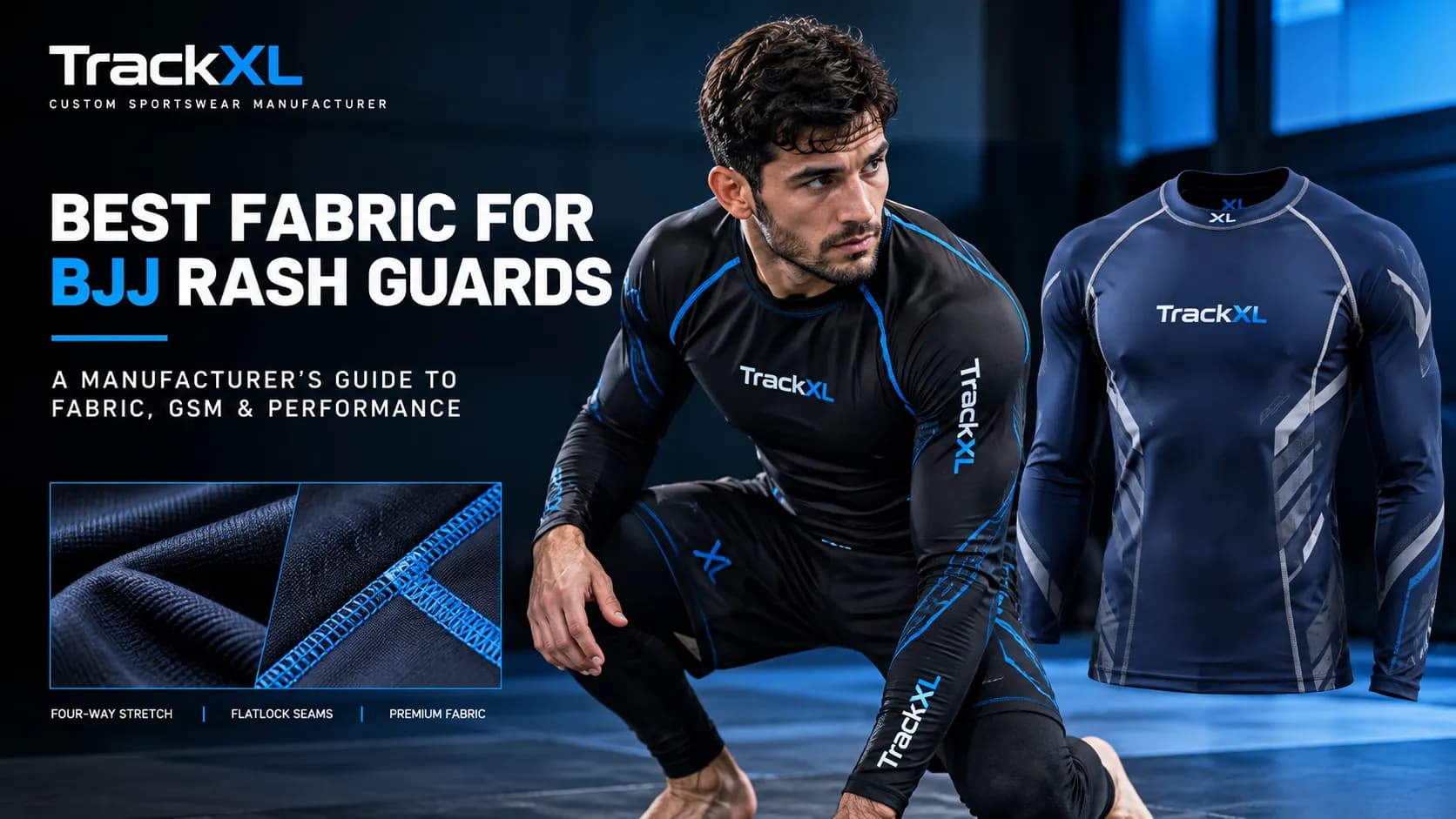
Four-way stretch fabric can stretch across both the width and length of the material, making it a useful option for close-fitting combat sports garments.
When selecting fabric for your collection, consider the following:
Stretch: The material should allow the wearer to move comfortably through a wide range of positions.
Recovery: After stretching, the fabric should return toward its original dimensions. Poor recovery can contribute to a loose or distorted fit over time.
Fit and compression: The fabric should provide the intended level of body coverage without feeling excessively tight or restrictive.
Opacity: The material should maintain suitable coverage when stretched. This is particularly important for fitted garments.
Durability: The fabric should be evaluated for pilling, seam performance, and changes in appearance after repeated use and washing.
These characteristics should be assessed together. A fabric that stretches easily but does not recover properly may not be suitable for a long-lasting compression garment.
5. How Important Is Flatlock Stitching?
Fabric is only one part of a well-developed BJJ rash guard. Stitching and garment construction also play an important role in comfort and durability.
Flatlock stitching is commonly used in performance apparel because it can create relatively flat seams that sit comfortably against the skin.
For custom rash guards, brands should consider:
Seam placement: Seams should be positioned to support comfort and freedom of movement.
Stitch quality: Stitches should be consistent, secure, and appropriate for stretch fabric.
Seam strength: Construction should withstand the demands of the intended activity.
Stretch compatibility: Seams should accommodate fabric movement without unnecessary restriction or thread breakage.
Finishing quality: Hems and openings should be cleanly finished and consistent across sizes.
The best stitching method depends on the garment pattern, fabric, and construction requirements. During sample development, examine the seams and test the garment through movement before approving bulk production.
6. Choosing the Right Printing Method for Custom BJJ Rash Guards
Custom artwork is an important part of building a recognizable combat sports brand. Logos, patterns, sponsor graphics, and color combinations can help distinguish your products from competing collections.
The printing method should be selected according to the fabric, artwork, and desired finish.
Dye-Sublimation Printing
Dye-sublimation is a popular choice for custom rash guards made from suitable polyester-based fabrics. The process transfers dye into the material, allowing detailed graphics and all-over designs without creating a conventional thick surface print.
It is particularly useful for:
Full-coverage graphic designs.
Complex patterns and gradients.
Multiple colors and detailed artwork.
Custom team designs and sponsor graphics.
Consistent branding across coordinated collections.
For the best result, artwork preparation, color settings, fabric selection, and production control must all be considered. A sample should be checked for color accuracy, print clarity, and coverage before bulk manufacturing begins.
Other Decoration Options
Depending on the fabric and design, brands may also consider screen printing, heat transfers, or other decoration methods for selected logos and details.
Not every method is suitable for every stretch fabric. The decoration should be tested to confirm that it remains comfortable and performs appropriately when the garment is stretched and washed.
7. What Should Brands Include in a Custom Rash Guard Specification?
Before requesting a quotation from a BJJ rash guard manufacturer, prepare a clear specification. This makes it easier to assess feasibility, compare quotations, and reduce misunderstandings during production.
Your specification should include:
1. Fabric composition: Identify the preferred fiber blend, such as polyester-spandex or nylon-spandex, where known.
2. Fabric weight: State your target GSM or ask the manufacturer to recommend suitable options.
3. Fit: Specify whether you want a compression fit, a standard close fit, or another intended silhouette.
4. Sleeve style: Decide between short-sleeve and long-sleeve designs.
5. Artwork: Provide your logo, color palette, placement requirements, and complete design files where available.
6. Stitching and construction: Identify any requirements for flatlock seams, reinforced areas, or specific hem finishes.
7. Branding: Include requirements for neck labels, size labels, care labels, and other private-label details.
8. Size range: Define the required sizes and provide a size chart or measurement specifications.
9. Quantity: State your estimated order quantity and size breakdown.
10. Packaging: Specify individual packaging, branded packaging, or other presentation requirements.
If some specifications are not yet finalized, you do not need to have every technical detail decided before contacting a manufacturer. Sharing your concept, intended use, artwork, and approximate quantity can provide a useful starting point for product development.
8. Why Sample Development Matters Before Bulk Production
A product may look excellent in a design file but perform differently when produced in fabric. Sampling allows brands to assess the actual garment before committing to a larger order.
For BJJ rash guards, a sample evaluation should include:
Fabric feel, stretch, and recovery.
Fit and measurements.
Opacity and coverage during movement.
Print clarity and color consistency.
Seam quality and construction.
Comfort during training movements.
Changes after washing and drying according to the care instructions.
Where possible, test the sample under realistic training conditions and review it against your approved specifications.
If changes are required, record the feedback clearly so the manufacturer can adjust the pattern, fabric, construction, or artwork before bulk production.
A well-managed sampling process can help reduce avoidable production issues and ensure the finished product is closer to your expectations.
9. Choosing a BJJ Rash Guard Manufacturer for Your Brand
Finding the right manufacturing partner is an important step when building a combat sports apparel business. Beyond the quoted unit price, brands should evaluate a manufacturer's ability to understand specifications, manage customization, communicate clearly, and maintain consistency between approved samples and bulk orders.
Before choosing a supplier, ask about:
Experience producing stretch performance apparel.
Available fabric options and material specifications.
Custom sublimation and branding capabilities.
Sample development and approval procedures.
Size grading and measurement control.
Minimum order quantities and production timelines.
Quality checks and export packaging.
Shipping arrangements for your destination market.
Request clear answers about what is included in the quotation. Fabric selection, labels, printing, packaging, and shipping can affect the final cost, so comparing prices on the same specifications is important.
The right manufacturing relationship should support your brand's current needs while giving you a clear process for developing future products.
10. Develop Your Custom BJJ Rash Guards with TrackXL
At TrackXL, we work with businesses seeking custom apparel manufacturing solutions for their brands and product collections. We understand that combat sports apparel requires careful attention to material selection, fit, construction, artwork, and branding.
Whether you are developing a new BJJ rash guard design, building a private-label combat sports collection, or expanding an existing product range, defining your requirements clearly is the first step toward a successful manufacturing project.
Your development brief can include your artwork, preferred fabric, target GSM, sleeve style, size range, estimated quantity, and branding requirements. If you are unsure which material or construction is appropriate, these details can help establish a starting point for discussing suitable options.
Looking for a custom BJJ rash guard manufacturer for your brand?
Contact TrackXL to discuss your design, manufacturing requirements, and quotation for custom combat sports apparel.
Visit our Combat Sportswear collection to explore our product range, or visit TrackXL to learn more about our manufacturing services.
Frequently Asked Questions
What is the best fabric blend for BJJ rash guards?
Polyester-spandex and nylon-spandex are common options. Polyester-based fabrics are particularly useful for compatible dye-sublimation printing, while nylon-spandex can offer a smooth hand feel and flexible performance. The best choice depends on your product requirements.
What GSM should I choose for a BJJ rash guard?
The appropriate GSM depends on your desired coverage, fit, fabric construction, and target price. Around 180–220 GSM can be a useful starting range for development, but samples should be evaluated before finalizing the specification.
Is polyester or nylon better for BJJ rash guards?
Neither is automatically better in every situation. Polyester-spandex can be a practical choice for full-color sublimation, while nylon-spandex may be preferred for certain premium-feel applications. Performance depends on the complete fabric specification and construction.
Is four-way stretch necessary for BJJ rash guards?
Four-way stretch is a useful feature for many fitted grappling garments because it supports movement in multiple directions. Stretch recovery, opacity, and overall fit should also be evaluated.
Can BJJ rash guards be manufactured with custom logos and designs?
Custom rash guards can be developed with brand logos, all-over graphics, color combinations, and private-label details, depending on the selected materials and manufacturing process. Artwork and customization requirements should be confirmed before production.
Should a brand order a sample before bulk manufacturing?
Yes. A sample allows the brand to evaluate fabric, fit, measurements, printing, stitching, and finishing before approving a bulk order.
What information is needed to request a custom rash guard quotation?
Share your design or artwork, preferred fabric if known, target GSM, sleeve style, size range, estimated quantity, branding requirements, and delivery destination. A manufacturer can then assess the specifications and discuss the next steps.
About TrackXL
TrackXL is a custom apparel manufacturer based in Sialkot, Pakistan, serving businesses seeking customized apparel and manufacturing solutions. Our focus is on helping brands develop products around their design, material, and branding requirements.